
A lot of arguments for legalizing autonomous vehicles in your city
Compare them to any other vehicle

I was listening with horror to a Boston City Council meeting today where many council members made it clear that they’re interested in effectively banning autonomous vehicles (AVs) in the city.
A speaker said that Waymo (the AV company requesting clearance to run in Boston) was only interested in not paying human drivers (Waymo is a new company that has never had human drivers in the first place) and then referred to the ‘notion that somehow our cities are unsafe because people are driving cars’ as if this were a crazy idea. A council member strongly implied that new valuable technology always causes us to value people less. One speaker associated Waymo with the Trump administration. There were a lot of implications that AVs couldn’t possibly be as good as human drivers, despite lots of evidence to the contrary. Some speeches included lots of criticisms that applied equally well to what Uber did to taxis, but now deployed to defend Uber.
Most of the arguments I heard were pretty wildly off-base. Many of the speakers didn’t factor in the basic safety benefit of AVs to the riders or pedestrians at all, and many of the arguments fell apart when poked at. Here are all my arguments for why a city should legalize AVs, with some concerns at the end:
There is no real difference for a city between an AV fleet and a very cheap rental car service
It is more elitist to use a personal chauffeur (a ride share driver) than to ride in an AV
AVs can make it much easier to take licenses away from the worst human drivers
AVs are ridiculously safe compared to human drivers
The most obvious reason to allow AVs in your city is that every time a rider takes one over driving a car themselves or getting in a ride share, their odds of being in a crash that causes serious injury or worse drop by about 90%. I’d strongly recommend this deep dive on every single crash Waymo has had so far:

This is based on public police records rather than Waymo’s self-reported crashes. It doesn’t seem like there have been any serious crashes Waymo’s been involved in where the AV itself was at fault. This is wild, because Waymo’s driven over 100 million miles. These statistics were brought up out of context in the hearing to imply that Waymo is dangerous. By any. normal metric it’s much more safe than human drivers.
40,000 people die in car accidents in America each year. This is as many deaths as 9/11 every single month. We should be treating this as more of an emergency than we do. Our first thought in making any policy related to cars should be “How can we do everything we can to stop so many people from being killed?” Everything else is secondary to that. Dropping the rate of serious crashes by even 50% would save 20,000 people a year. Here’s 20,000 dots:

The more people choose to ride AVs over human-driven cars, the fewer total crashes will happen.
One common argument is that Waymos are very safe compared to everyday drivers, but not professional drivers. I can’t find super reliable data, but ride share accidents seem to occur at about a rate of 40 per 100 million miles traveled. Waymo in comparison was involved in 34 crashes where airbags deployed in its 100 million miles, and 45 crashes altogether. Crucially, it seems like the AV was only at fault for one of these, when a wheel fell off. There’s no similar data for how many Uber and Lyft crashes were the driver’s fault, but they’re competing with what seems like effectively 0 per 100 million miles.
A transition to any new, safer mode of transit will still involve people dying in that new mode. What matters is the rates of death.
Motorcycles are the single most dangerous way to travel, by a long shot.
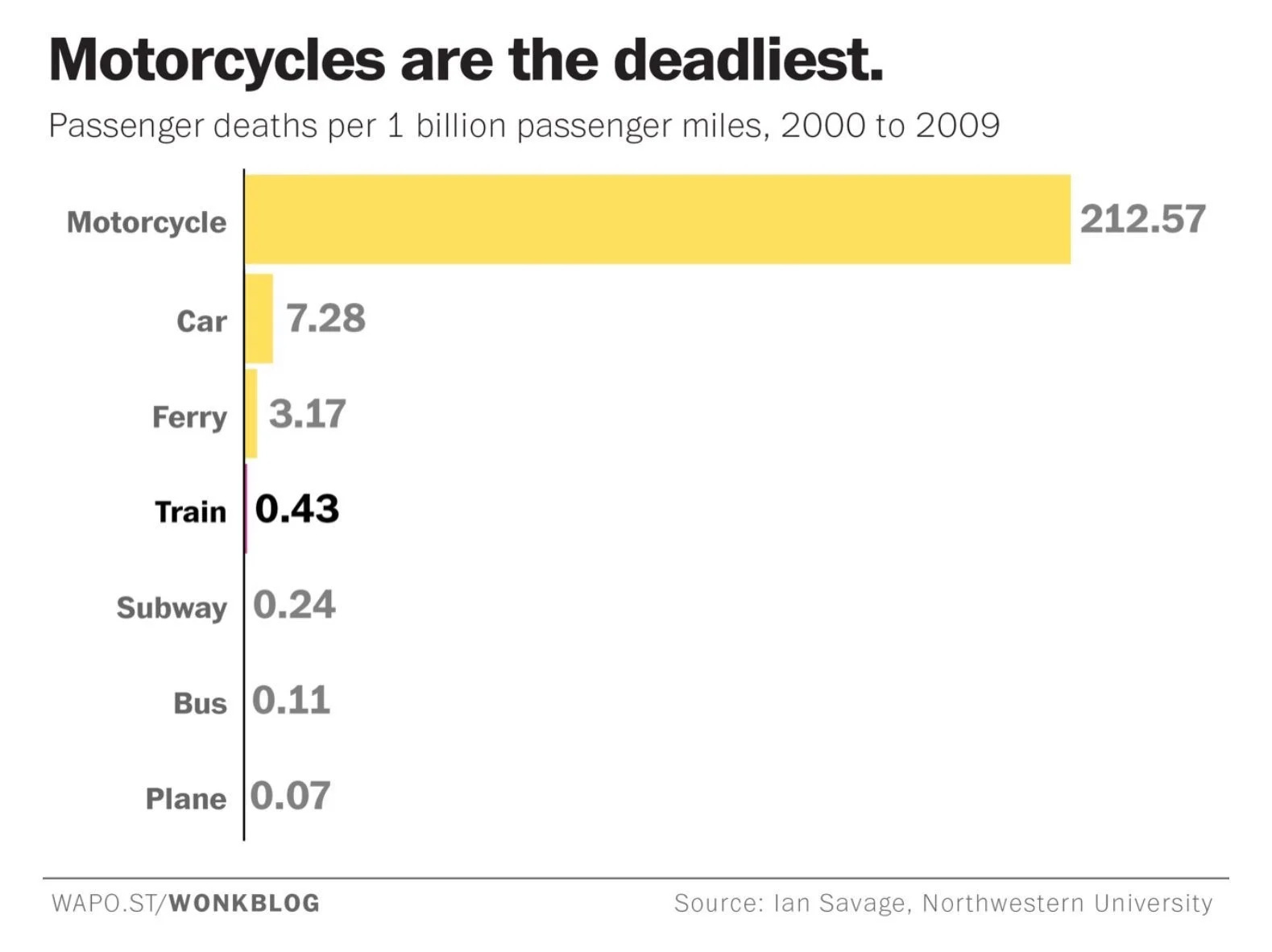
If we had everyone who currently rides a motorcycle drive a car instead, they would all be much safer. But some of them would still die in car crashes. Some people might look at those car deaths and say “We shouldn’t have had them switch, it turns out cars were what was dangerous.” This is a really bad way to think. What matters is reducing the total number of people who die,
There has recently been a lot of attention on Waymo killing a cat in San Francisco. A city supervisor made this ridiculous video where she declares that this means Waymo should be put up to a vote in each individual county to decide whether it has a right to operate there.
In Waymo’s first 100 million miles of travel, it seems to have killed two pets. In both cases it doesn’t seem like it could have done anything different. In the cat case, the cat darted under the wheel while the car was pulling away. In 2023, a dog ran out in front of the Waymo, which correctly identified it as a dog but wasn’t able to stop in time.
In comparing this to human drivers, we need to look for similar situations where cars are:
Driving in a city.
Hitting pet-like animals that can be reported (we shouldn’t measure all animals, because there isn’t good data on this for either Waymo or human drivers).
There’s not much good data on this, but the little we have implies that humans kill cats and dogs way more often. A study in Baltimore in the 80’s estimated that human drivers kill around 5,000 cats in the city each year. Current government records say about 3.18 billion miles are driven in Baltimore each year. Combining these two stats implies that human drivers kill ~150 cats for every 100 million miles driven. So it seems like human drivers are 75x more likely to kill pet animals compared to Waymos. This should make us want to replace human drivers with Waymos for pet safety, but because Waymos are new and weird, people are hyper-focusing on this one case where they killed a cat and ignoring the much much higher rate of human drivers killing cats and dogs.
If we refuse to move to a safer mode of transit because it’s not perfectly, 100% safe in all cases, tens of thousands of additional people will continue to die for no reason.
Protecting ride share driver jobs is a bad basis for policy
Should we build fewer bike lanes to save Uber jobs?
You’re out and want to get somewhere, and have a few options:
Walking
Public transit
Driving your own car
Biking
Taking an Uber
Every time anyone chooses any option besides Uber, less money goes to Uber drivers. If you make any of the other options better (building bike lanes, improving public transport, or making your city more walkable) you are incentivizing people to pay Uber drivers less often. A better bike lane means Uber drivers lose work. Walkable, safe pleasant streets mean Uber drivers lose work. Better public transit means Uber drivers lose work.
Jobs driving for Uber are not essential, what’s essential is being able to get around a city safely. In every other circumstance, we’re willing to sacrifice Uber jobs for the sake of making a city safer and easier to get around. AVs are another option to make a city safe and easy to get around. We shouldn’t ban them to preserve Uber jobs. The priority is the millions of people who want to get around the city quickly and easily. Uber jobs are good insofar as they help with that. If you wouldn’t block a renovation of a subway system because it would harm Uber jobs, you shouldn’t block AVs either.
Sometimes people bring up ride share jobs and public transit in the same sentence, like “We need to think about how these will affect public transit, and ride share driver jobs.”
I think this is weird, because each of these two is already pretty directly harming the other. If public transit were worse, people would use ride shares more often and there would be more jobs. I realize there are some ways they benefit each other, but the statement sounds to me kind of like saying “We need to think about how this new competitor will affect both Coke and Pepsi.” If you’re very pro public transit, you’re not looking to perfectly preserve ride share jobs, and vice versa.
Ride share jobs can be pretty bad
Uber and Lyft are predatory with their drivers, implementing policies that maximize corporate profits while shifting financial risks and costs onto workers who are classified as independent contractors rather than employees. This classification denies drivers access to benefits like health insurance, paid time off, unemployment insurance, and retirement contributions that traditional employees receive. Drivers use their own vehicles, and often fail to properly incorporate the cost of their vehicle’s depreciation into their own cost-benefit calculation of working with the company.
The companies have also been criticized for:
Opaque pay structures that make it difficult for drivers to understand how their earnings are calculated, with the companies taking increasingly larger cuts of rider fares over time.
Algorithmic management that controls drivers through ratings systems, surge pricing manipulation, and acceptance rate requirements without meaningful transparency or appeal processes.
Unilateral rate changes where the companies can reduce driver pay rates at any time without negotiation.
Vehicle expenses being entirely borne by drivers, including fuel, maintenance, insurance, and depreciation, which can significantly eat into their earnings.
Lack of job security, with drivers subject to sudden deactivation with limited recourse.
Psychological pressure tactics like gamification features and persistent notifications designed to keep drivers working longer hours.
Driving is also one of the most dangerous things we normally do. Driving as a job is inherently dangerous.
These are not good jobs. Policy should focus on getting workers access to high-quality well-paying jobs, not preserving Uber and Lyft’s pretty shady business model.
Losing these jobs is still a loss
Despite all this, it’s obviously still the case that losing these jobs would be a general loss. Ride share driving might represent an important opportunity for low-skill workers. Interestingly, a much higher percentage of ride share drivers have college degrees than the general working population (40.0% compared to 28.4%). Still, ride share jobs can give useful opportunities to workers without college degrees. Reducing the number of such jobs might therefore harm low-skilled workers. I support these types of jobs existing, because among other things they give very recent immigrants a foothold in the country they can build up from, but it’s important to understand the realities of what the jobs themselves are like. Losing these would have negative effects on workers, but these effects need to be weighed against the positives of AVs.
Uber jobs can seem like pretty bad options. There was a lot of opposition to Uber when it arrived. But if you think Uber jobs are worth all the bad aspects because they give low-skilled immigrant workers a leg up, you should consider other “bad jobs” your city shouldn’t regulate away. If your beliefs about what counts as a bad job would’ve caused you to ban Uber in 2011 to preserve taxi jobs, and now you see Uber as essential for low-skill workers, consider other industries where regulations might be preventing Uber-like jobs from popping up. If you’re willing to go so far as banning new vehicles to save these jobs because they’re so important for low-skilled workers, you should be willing to open up other similar options that might not have the salaries or job security you’d want if they also give low-skilled workers a leg up.
Would you ban AVs if they were already widespread to create Uber driver jobs?
Suppose we lived in a world where AVs were widely used. You’re brought a policy proposal: we could create a lot of jobs for more Uber drivers if we banned AVs. These jobs would be pretty predatory and take advantage of the drivers, and would be one of the more dangerous jobs you can do, because driving is dangerous. The odds of the riders being in serious car accidents would be 10 times as large as before the ban. You’d be growing everyone’s risk by an order of magnitude. Would you choose to ban AVs in this case? If not, you shouldn’t ban AVs now.
There is no difference for a city between an AV fleet and a very cheap rental car service
Imagine a very cheap rental car service appeared in your city. They have a policy where they drive the car to you for you to drive around, and pick it up for you after. To my knowledge, this kind of rental car service isn’t banned anywhere. If this service were cheap enough, it would compete with Uber and Lyft and sometimes cause drivers to lose jobs, because people would just be driving themselves to where they want to go. If this rental service became too popular, it would lead to worse traffic in the city as more cars circled around being delivered to drivers. This is the major risk of a service like this.
An AV is identical to this service. The only difference is:
AVs are wildly safer compared to human drivers.
The rider happens to be sitting in a different spot in the car.
The rider can do other things while still driving safely.
Outwardly, there is no other difference. If you wouldn’t ban the rental car service, you shouldn’t ban AVs either.
It is more elitist to use a personal chauffeur (a ride share driver) than to ride in an AV
Sometimes people will frame using AVs as an elitist option. Maybe the rider doesn’t want to take a ride share because they don’t want to have to interact with another person, maybe they’re so elitist that they find the idea of interacting with everyday people driving ride shares unpleasant.
In my opinion this gets it exactly backwards. Suppose autonomous vehicles had somehow come before ride share cars. Everyone normally takes a robot taxi, but suddenly the option is available to pay a human to be your personal chauffeur throughout the city. It seems obvious that this is the more elitist option of the two.
In general I don’t like feeling like I’m being served. I prefer to drive myself as opposed to paying someone to drive for me, for the same reason I prefer to cook and clean over paying someone to do it for me. In the same way that it’s less elitist to use a Roomba instead of hiring a maid service, I think it’s less elitist to ride in AVs than it is to hire a human driver to be your personal servant for 10 minutes at a time.
If you want car ownership to stay legal in your city, any argument to ban AVs that works equally well as an argument to ban cars is bad
A lot of arguments against AVs seem to be arguments against personal ownership of cars in general. While I’m open to these arguments (I hate cars in cities) a lot of people clearly support keeping cars in cities, but use arguments against AVs that apply equally well to cars. For example, the argument that driving somewhere in an AV takes work from an Uber driver applies equally well to driving in your personal car.
Eyes on the street
One argument that came up in the hearing was the idea that human drivers are important because they can see people in trouble or crime happening, and pull over and stop it. AVs don’t have drivers to stop and help.
This argument is implying that we should artificially boost how often Uber is used to have more people watching the street. Imagine if a city council member proposed funding Uber drivers to aimlessly drive around the city and observe and watch out for anything bad happening. This would obviously be ridiculously inefficient, and terrible for the environment. More pedestrians would be harmed by the total air pollution from the cars than helped by individual Uber drivers interfering to stop crimes.
If we want to make policy to have more people watching the street to keep people safe, we should just hire more police, community patrols, or pay everyday individuals to stand around observing an area to see if people need help, install security cameras in more places, or follow Jane Jacobs’ strategy of making streets more walkable and appealing for lots of people to be on. Uber and Lyft are terrible public safety interventions. Imagine if a politician proposed funding Uber and Lyft more to “make people feel safe and seen on our streets.” This would be obviously ridiculous.
This argument also applies to above-ground trains. Many above-ground public trains can’t stop in time if they observe a crime happening. We don’t block building trains because they can’t stop in time to prevent nearby crimes. We shouldn’t hold AVs to a different standard.
This argument shows an important common mistake
This argument is very specific and something I haven’t heard outside this meeting. I bring it up because it’s a good example of a broader pattern we should expect to see in conversations about AVs: people feel very strongly that there should be a human in the driver’s seat, and the experience that lack almost like it’s a physical presence. So when an AV doesn’t do something that a human driver would like stepping out to help someone on the street, people ascribe a ton of responsibility to the AV, like there was supposed to be a human there, and the lack of the person is responsible for the bad thing happening. But almost everything we do causes these “lacks of people” in specific places. If a popular restaurant opens up, there will be fewer people hanging around other places the restaurant took business from, and therefore fewer people to intervene if something goes wrong. The only reason people don’t hold the restaurant accountable is that they see restaurants as normal, and AVs as weird. We can’t make it a goal of policy to perfectly equally distribute people in every public place in a city. A talking point that says “We need to require human drivers so there are more eyes on the street” is identical to saying “We need to require more everyday people to equally spread themselves out on every street.” This only makes sense if you think of the AV as having some unnatural lack that urgently needs to be filled. If instead you think “It is okay for there to sometimes or often be no drivers on a street” it doesn’t look objectionable.
In all conversations about AVs, watch out for this general pattern: people treating them as weird and different to the point that they’re expecting things they don’t expect in any other circumstance, like policy that perfectly spreads people out across a city. Watch out for when they treat the lack of a human as some kind of physical entity that can be responsible for bad things happening. A lot of things in society create these lacks, but AVs are getting special condemnation for it because they’re seen as weird.
AVs can open up opportunities for disabled riders
Another point brought up was that some disabled people need human help when entering a car, and AVs can’t provide that. For what it’s worth, the council meeting speakers representing different disabled communities in Boston seemed to mostly be pro legalizing AVs.
Uber and Lyft have not gone out of business where AVs are operating. Companies know that there is going to still be a lot of demand for human drivers into the future. Eventually, autonomous vehicles could also get good enough to provide help for disabled riders. For many disabled people, AVs can give them access to ride share-like experiences they don’t otherwise have. A common issue some disabled people have with ride shares is not being able to take their service animals on the ride due to a policy by the driver. AVs can consistently allow service animals because there’s no driver to get scared.
Right now, AVs do not seem likely to displace Uber or Lyft. They exclusively give disabled riders an additional option. For some, this will allow them to use ride hailing services they can’t otherwise use due to their service animals.
Waymos are fully electric
An underrated aspect of Waymos is that they’re fully electric. If a rider chooses a Waymo over an Uber or Lyft, they’re often choosing an electric vehicle over an ICE vehicle. This on its own should be a big selling point for making them more available. We need to get as many ICE vehicles off the roads as fast as possible to reduce CO2 emissions and air pollution.
Nothing makes the world more human than safety
People sometimes talk about AVs making the world “a little less human.” This is the least relatable talking point to me. Cars as they exist are profoundly grizzly and inhuman.
I’ve been in two serious car accidents. Neither was my fault at all. There wasn’t anything I could’ve done differently. One left me in pain for a few months. In both, I was really lucky to not get more hurt. After a serious car crash, you think a lot about how you can work so hard to build up a great life and community and put in a ton of effort to learn a lot, and that can all be erased in a moment by a bad decision by another random driver. This is one of the most inhuman parts of our daily lives. I would so obviously rather spend the rest of my life constantly walking by empty driverless cars aimlessly but safely circling around than be in another accident like that.
It’s inhuman that 40,000 people die every year on American roads. In comparison to those deaths, a basically aesthetic objection to an incredibly safe car just doesn’t seem to matter. In conversations about this, I would like more people to feel in their bones how awful cars as they exist are.
If a vehicle is safe, the default should be legalization
It’s kind of crazy to me that we haven’t banned motorcycles yet.
AVs haven’t hit the 1 billion miles traveled mark. When they do, I expect them to have a significantly lower death rate than regular cars. If a vehicle is safer for the driver and pedestrians than a regular car, I think people should be allowed to ride in it around a city.
More generally, AVs give a lot of people the freedom to go places they might not otherwise be able to access. This is good. If we’re so wildly libertarian that we still allow people to still drive motorcycles (in my opinion, this should change), I think we should also allow people to use AVs if they want.
If a vehicle is proven safe, the default should be legalization. People should be able to choose for themselves how they want to get around. Second order effects matter, but I’d rather not have the government unpacking every last possible second and third and fourth order effect of different types of new vehicles, because they don’t really do this at all with vehicles as they currently exist. Gas powered cars create air pollution, climate change, and often kill people. If your city hasn’t held any meetings on banning them recently, I think they’re not seriously considering the second order effects in the way they are with AVs. Holding AVs to a much higher standard than ICE cars seems like a way of locking in our very bad current transit equilibrium.
In DC as food delivery apps have led to a lot more motorized bikes in the city, I’ve found myself at much greater risk of getting hit in crosswalks, because they ignore stop lights way more often. I think this is bad, but it’s not bad enough that I think the apps or vehicles should be banned. In comparison, we’re debating a vehicle (AVs) that’s way safer than the average human driver. It’s pretty easy for me to say that because I’m fine with the app delivery bikes, I’m also fine with something much safer.
AVs can make it much easier to take licenses away from the worst human drivers
An underrated benefit of potential future mass availability of self driving cars will be that it will be way easier to take licenses away from the most dangerous drivers without ruining their lives. The reason it’s so hard to take licenses away in America right now is that public transit is so bad that in most places, not being able to drive is effectively cruel and unusual punishment. AVs will fix that. People could be ordered to only use autonomous vehicles. Maybe there will specially designed autonomous-only cars? I don’t know.
Most of the problems with traffic safety in America are caused by the bottom fifth of drivers, and these problems often involve alcohol. The single most promising way to improve road safety is getting people who drink and drive, and the otherwise very worst drivers, off the road. AVs can remove the main barrier to doing that: the life-ruining consequences of losing your license.
Real problems with AVs
Cybersecurity
Autonomous vehicles are just computers driving cars. This makes them vulnerable to hacking. A successful cyberattack could let hackers control steering, brakes, and acceleration, turning vehicles into weapons. Worse, attackers could target entire fleets or traffic systems at once, causing mass accidents or citywide shutdowns. AVs also collect massive amounts of personal data about where people go and when, making data breaches a serious privacy and safety threat.
AV companies are well-aware of cybersecurity issues, but the tech is new and oversight of how companies are dealing with the problem seems necessary.
Could make traffic worse
If there’s a huge fleet of ride share cars added to a city network, it seems likely that on net these could make traffic worse. There’s a trade-off here where a much higher percentage of cars on the road would be driven by incredibly safe drivers, so though this would increase traffic, it seems likely to seriously reduce injury and death as well. How to think about this trade-off is complicated, but we should lean in favor of saving lives and preventing injury at the cost of a little more time on the road. This is what we do when we impose traffic slowing measures.
Another key consideration is that a lot of traffic is caused by car wrecks. The main problem in a car wreck is obviously that people got seriously hurt, but any technology that reduces the rate of car wrecks also reduces the rate of massive traffic backup. If we want to reduce traffic, it’s better to opt for vehicles with wildly low rates of causing car wrecks.
Environmental impact
AVs seem likely to cause more people to take car trips because of their convenience. This is bad and will be harmful for the environment. But the solution to environmental problems with cars is not to prop up Uber and Lyft, it’s to build out better public transportation networks. Eventually, AVs getting good enough could become government-owned. AV buses could open up more routes. Being part of the AV rollout might help public transportation better. But this is all very uncertain. It’s important to note that Waymos are fully electric. Electric cars still use a lot of energy, but emit way less than the ICE cars many Uber and Lyft drivers use.
I believe there’s a missing nuance in why people oppose AVs : there’s a perception bias of giving up liberty. Roads are still human spaces, where human agency and autonomy still precedes algorithmic rules and order. Roads still constitute a significant portion of our perception of daily space, livelihood, the means to get to family outings or an evening stroll to a nearby dine out. With AVs, there’s an artificial sense of giving up these spaces to automations and procedure. There’s a fair amount of masked conflict(however true or false they are factually) that isn’t being communicated or probably recognised. Effectively, the opposition is a critique of an algorithmic enclosure to what is fundamentally a very human, public commons. Instead of making this a nudge based shift, there’s a strong sense that it’s an imposed change that puts a disproportionate bias on eliminating the human agency here.
Here's what autonomous vehicles do NOT do
Drive drunk or high
Road rage
Flee accidents
Fall asleep at the wheel
Look at at their phone while driving
Ignore traffic laws
Tailgate , Rush, or Rubberneck
Get angry at other drivers
Do donuts on the freeway as recreation