
When making cuts for the climate, always consider the value you're getting per unit energy, not just the total energy used
This needs to be a basic part of our climate ethics

Suppose I said:
I used to be worried about the emissions from my massive car, but then I found out the children’s hospital down the street causes WAY more emissions. That’s clearly a bigger problem for climate, so instead of selling my car I’m going to focus on shutting down the hospital.
Obviously this is wrong, but why?
The answer is that when deciding what to cut for the climate, we need to not only consider the total emissions, but the value we get per unit of emissions. The children’s hospital emits way more than any one car, but if we add up the number of cars it would take to equal the emissions of the hospital, it would be easier to live as a society without that many cars than it would without the hospital. We could switch to electric cars or ask people to drive less. So if we’re going to make cuts for the climate, we should prioritize stuff that isn’t producing much value per unit of emissions.
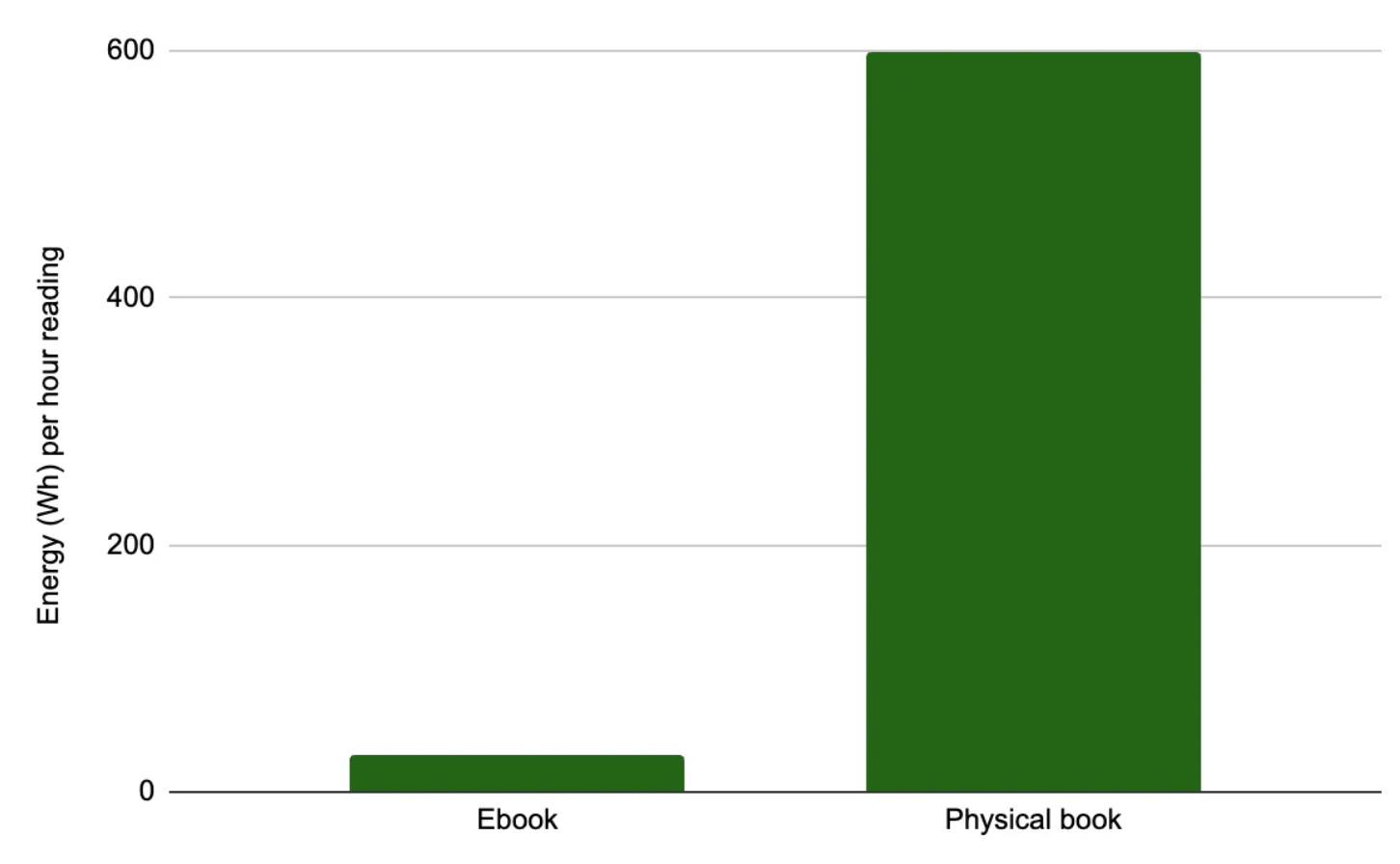
I’ve posted before about how computing is one of the most energy efficient things we do. We should basically expect everything we do on computers to be one of the last things we ought to cut for the climate, because computers give us incredibly high amounts of information per unit energy. That’s what they’re designed to do! I use the example of a physical vs digital book. If you consider the energy cost of making and shipping the book, it uses way more energy per hour of reading compared to an ebook.
The reason I’m posting this is that I was just sent this picture from the UK:
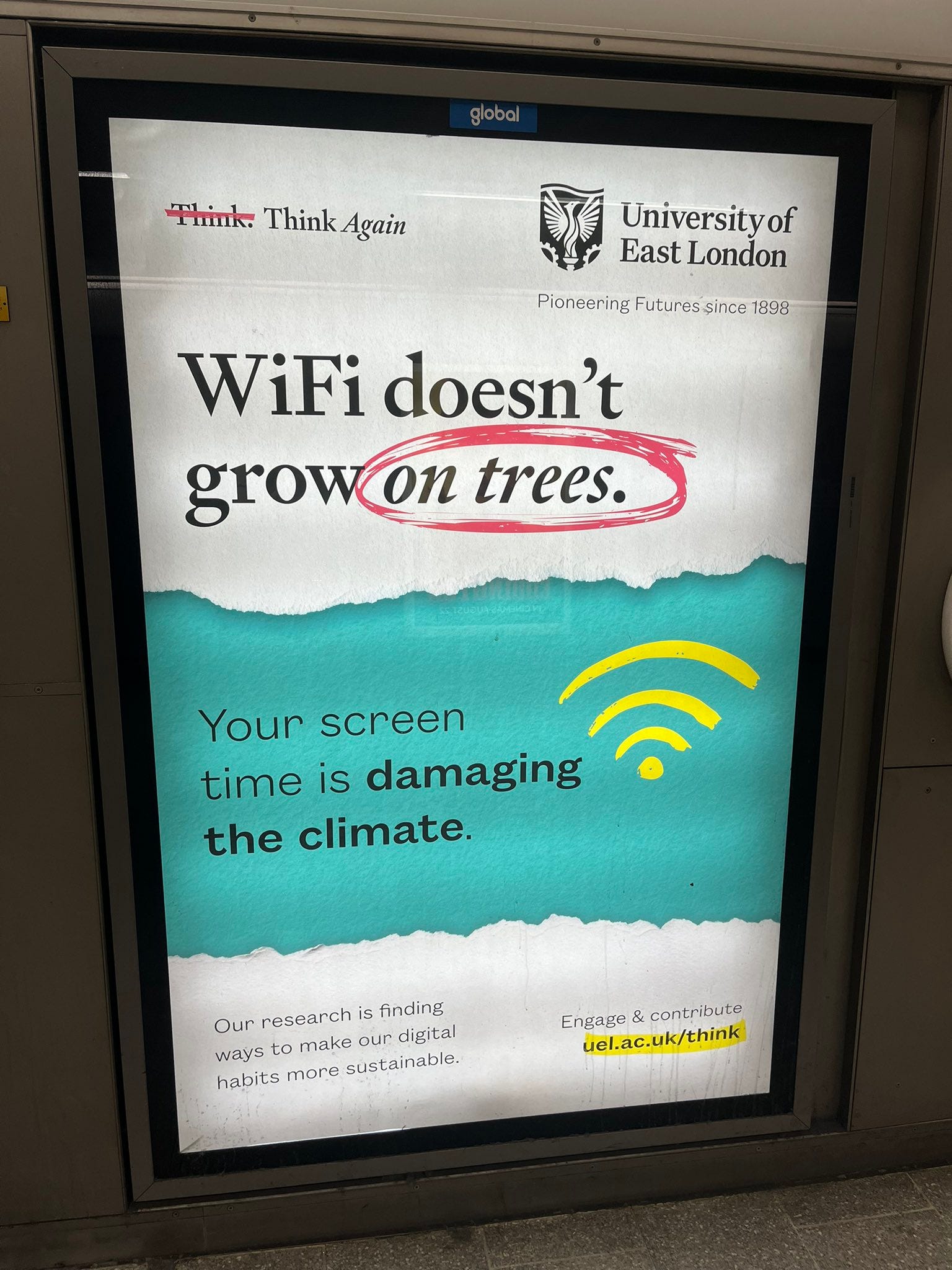
I’m confused about what’s going on in the UK recently. WiFi (and the internet more broadly) is one of the highest value ways we use energy, period. It’s a miracle that we can transmit so much information through the air.
Each WiFi router uses as much power as a single LED bulb.
As I write this, I’m on a couch in my apartment. Above me are 5 LED bulbs.

If I wanted to save energy, and could choose between unscrewing one of the bulbs or getting rid of my WiFi router, the choice is so obvious it seems silly to even think about. The WiFi router is giving me way more value per unit of energy. I would cut most of the energy I use in my home before my WiFi router. It’s that valuable to me.
Someone walking by this ad this might feel guilty about using WiFi as a result. That’s ridiculous. You should feel as guilty about your WiFi as you do about using a single LED bulb. That is, not.
I think a lot of British people use WiFi as a stand-in for the internet more broadly (in a way Americans like me don’t) so this ad probably reads differently to an American than a British person. The ad ends with “Our research is finding ways to make our digital habits more sustainable.” That at least is a nice shift of the burden of blame from individual people toward trying to solve the problem systematically. They probably don’t only mean WiFi routers, but the entire infrastructure of the internet.
But the entire infrastructure of the internet is still one of, if not the, most energy efficient parts of our society.
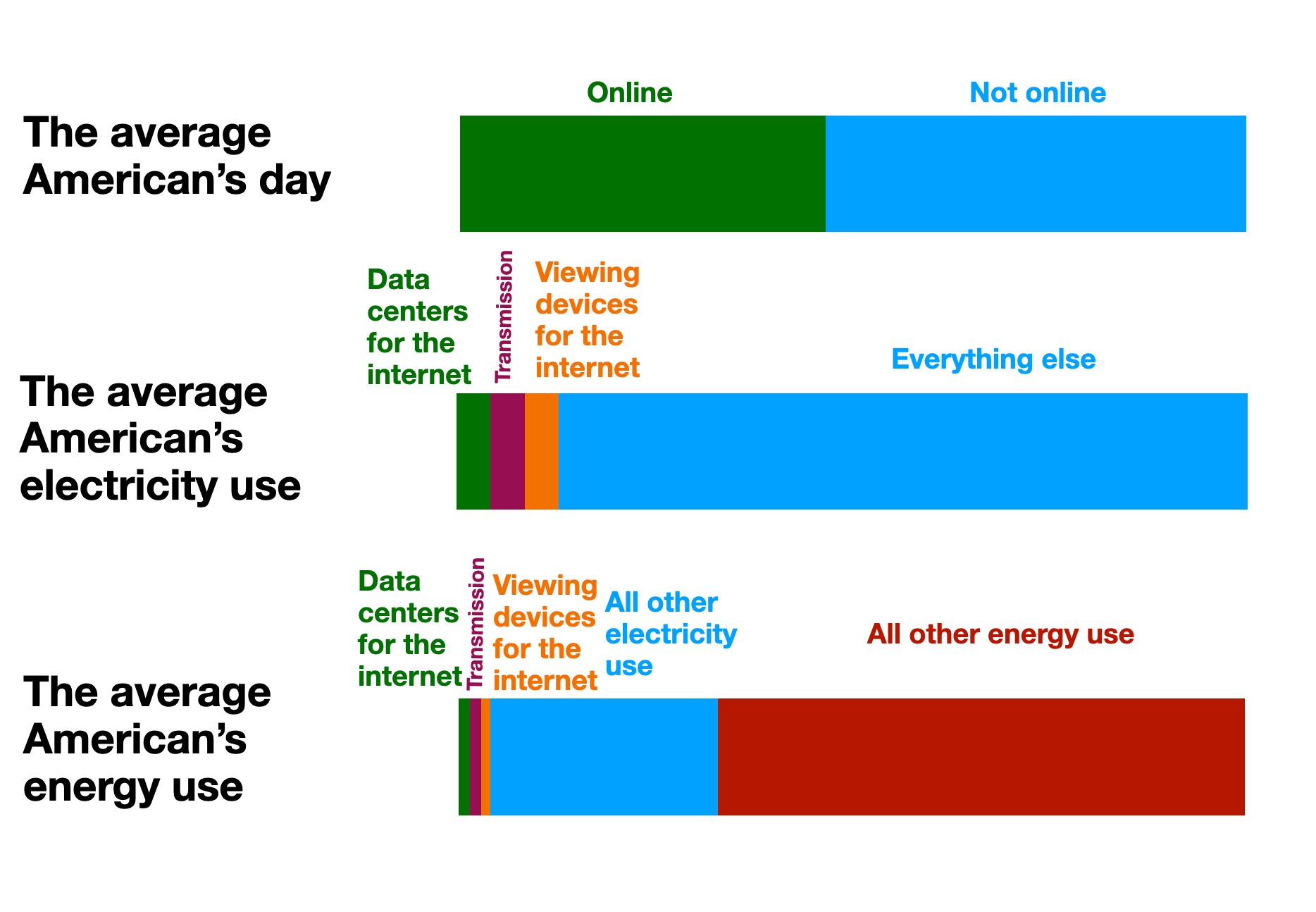
The internet has already been massively optimized to use as little energy as possible to transmit the most data possible. Consider all the streamed movies that could have been physical DVDs, and all the carbon costs of making, shipping, and housing those DVDs. The music that could have been physical CDs. The written text that could have been printed on physical paper. The internet is a collective gigantic win for the climate. It’s a huge increase in the value per unit of emissions in our society. Giant amounts of effort have already gone into optimizing the energy and resources used by computing and data transmission. Spreading the message that “Your internet use is harming the climate” seems identical to writing about how your bicycle is actually bad for the environment because it cost resources and emissions to make, while ignoring the fact that many people are still driving instead of biking.
It seems like a lot of people have forgotten that the internet has allowed us to do way more while emitting way way less. All they can see is that it’s currently using energy, and so it must be bad for the climate. They look at data centers managing the internet, see that they use a lot of energy and water, and miss how much more energy and water would have been spent on the production of the physical goods the internet is replacing. They’re not considering the internet’s value per emissions, only its total emissions.
If you follow the link on the ad, you’re taken to this page, with this introduction:
The growing demand for digital services has created a new challenge for the environment. Sending emails, texts, browsing the internet, uploading videos and more all come with a cost – a few grams of carbon dioxide are emitted due to the energy needed to run your devices and power the wireless networks you access.
With over four billion people across the world using the internet, it is estimated that three per cent of world electricity is consumed by data centres – accounting for more greenhouse gas emissions than the entire aviation industry.
It’s true that the infrastructure of the internet as a whole uses about the same energy as the aviation industry. What they’re leaving out is that everyone on Earth is spending an average of 7 hours a day online. It’s a miracle that the internet only emits as much as the aviation industry given that everyone on Earth is spending half their waking lives on it. In comparison, the average person on Earth takes one flight every 2 years. The only way you can compare a service people spend half their waking lives on to a service that most people never use, and that averages out to a few hours ever 2 years per person, is if you’re not considering the value per emissions and only looking at total emissions. That’s ridiculous.
We should be upset when people spread sloppy messages about our digital infrastructure without bothering to consider the value per unit emissions. These sloppy messages harm the climate movement. If I were a climate denier and wanted to harm the movement as much as possible, I’d consider running ads like this to alienate everyday people. We should be more up in arms that messages like this are associated with the urgent need to drawdown our emissions and save the world from extreme impacts of climate change.
We need to be adamant that if you aren’t willing to compare the value per emissions (and not just look at total emissions) you’re confused about the most basic questions of climate ethics and should educate yourself before speaking for the movement.
How do we decide what’s valuable in the first place?
Obviously it’s up for debate what’s actually “valuable.” We want to live in a pluralist society where many different rival conceptions of the good life can coexist. A devout Catholic and devout Muslim should, in our ideal society, be able to live side by side without accusing the other of wasting emissions on religious services promoting a false God. Our measure of value needs to be general enough to allow everyone to pursue their reasonable conception of the good life. So in measuring value, we can’t make very contentious claims about how people should be living their lives. The Catholic and Muslim should be able to use these rules consistently without condemning the other for “wasting” emissions on a different religion.
It seems like the best (flawed) measure of value is whether something that emits allows people to get what they personally are looking for out of life, regardless of what that is. A Catholic and Muslim may disagree on which religion should be promoted, but they can agree that they want their children to have access to medical care, and can agree that when they drive to their religious services and have the choice between an electric and gas powered car, the type of car doesn’t make much difference in achieving their ends.
This is why I’m wary when people start saying that something is bad for the environment because the activity itself is a waste of time. We live around too many different people with far too varied interests and goals to make contentious claims about what goals are valuable and what aren’t. I don’t play video games solo1 and worry they’re often a waste of time, but so many people seem to get real joy from them that I’m not going around saying they’re environmentally wasteful purely because the games themselves are valueless. If a significant number of other people want to play them, that should be the final word on how we assess their value, so that’s what we should compare to their emissions to make decisions about what to cut.
My impression is that the most promising places to make cuts in your personal life are:
Flying vs. any other type of transportation
Driving vs. walking or biking
Eating less meat
Optimizing your home with better heating insulation and up-to-date electronics (LEDs vs. incandescents etc.)
What you do with your computer is unlikely to make the cut, even if you factor in the entire infrastructure supporting your computer use. Computing is efficient.
I will join for an Age of Empires LAN party tho
My gawd, this is so right on. Especially "If I were a climate denier and wanted to harm the movement as much as possible, I’d consider running adds like this to alienate everyday people"
I hope you and Hannah Ritchie are friends.
Andy, can you devote an article to Jevons Paradox? And relate it to your other posts? Would be a valuable addition to your series of writings ...